Just before you fall asleep, when everything slows down — a soft tapping at the window. Not loud. Not urgent. Just enough to be noticed.
A flash of blue and gold. Eyes that understand more than words ever could.
One night it's the deep green breath of the Amazon. Another, the frozen silence of the Arctic sky. Or golden dunes where the wind carries ancient stories.
ARI is not just a bird. He is a guide, a friend, a keeper of secrets.
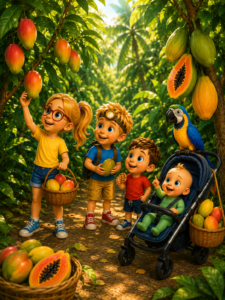
Join Sophia, Bembem, Lelo and baby Theo on unforgettable adventures through faraway lands filled with mystery, courage and magic — and discover the Magical Secret of the Martinosa Rainforest.
Peek inside the book
A taste of the Martinosa
A rainforest like no other — glowing with the colours of a thousand crayons, full of creatures, whispers and things that cannot quite be explained.
Blue-and-yellow macaws can live for up to 60 years in captivity — one of the longest-lived parrots. In the wild they typically live 30–35 years. ARI could be your friend for your entire life!
🧠
As smart as a young child
Macaws can solve puzzles, use tools, and learn to associate words with meaning. Scientists compare their cognitive abilities to those of young human children — which is exactly why ARI feels so real.
💪
Their beak exerts up to 400 PSI of pressure
A blue-and-yellow macaw's beak can exert around 350–400 pounds per square inch — powerful enough to crack open Brazil nuts with ease. It's like having industrial pliers built into their face, which is very useful in the rainforest.
👁️
They see ultraviolet light
Macaws see UV light — completely invisible to humans. Flowers, feathers and fruits glow in secret patterns that only ARI can see. The world literally looks different to him.
💑
They mate for life — forever
Once a macaw finds a partner, they stay together their entire lives. They sleep side by side, share food and preen each other every single day. No exceptions.
🗣️
They learn over 100 words
Blue-and-yellow macaws are among the world's best talkers. Some learn over 100 words and actually use them in the right context — not just repeating randomly.
🪶
The blue feathers have NO blue pigment
This is mind-bending: ARI's blue feathers contain zero blue pigment. The colour comes entirely from the feather's microscopic structure bending light — like a living prism.
🌱
They plant hundreds of trees
By eating fruit and flying far, macaws drop seeds across the forest — planting hundreds of trees in a lifetime without knowing it. ARI is secretly one of the rainforest's most important gardeners.
🎵
The chick calls from inside the egg before hatching
About 24 hours before hatching, macaw chicks begin vocalising from inside the shell — long before they break out. Their parents listen closely and respond, beginning the bond between parent and chick before the egg has even opened.
🌍
Their real name is Arararuna
In Brazil, the Blue-and-Yellow Macaw is called Arararuna — from the Tupi words arara (macaw) and una (dark/black), meaning "big dark macaw." The Tupi people of the Amazon lived alongside these birds for thousands of years.
Q1. How long can a Blue-and-Yellow Macaw live in captivity?
✅ Amazing! Up to 60 years — one of the longest-lived parrots!
❌ Blue-and-yellow macaws can live up to 60 years in captivity!
Q2. What is the real Brazilian name for the Blue-and-Yellow Macaw?
✅ Arararuna! From the Tupi people of the Amazon.
❌ It's Arararuna — a Tupi word from the indigenous people of Brazil!
Q3. Why do macaws gather at riverbank clay licks?
✅ Clay licks are nature's pharmacy! The clay neutralises toxins in seeds and fruit.
❌ Macaws eat clay to neutralise natural toxins in the seeds and fruits they eat!
Q4. A macaw's blue feathers look blue — but what is the surprising truth?
✅ Mind-blowing! Zero blue pigment — pure physics, like a living prism!
❌ There's NO blue pigment! The colour is created by the feather's microstructure bending light!
Q5. Blue-and-Yellow Macaws find a partner and stay together for how long?
✅ Forever! Macaws are completely faithful — every single day of their lives!
❌ Macaws mate for life — completely faithful to one partner!
Q6. What kind of light can macaws see that is invisible to humans?
✅ Yes! Macaws see UV — flowers and feathers glow in hidden patterns only they can see!
❌ It's ultraviolet light — macaws see a hidden world invisible to us!
Q7. How does a macaw help the rainforest grow without even knowing it?
✅ Macaws are secret gardeners! One macaw can plant hundreds of trees in its lifetime!
❌ By eating fruit and flying far, macaws drop seeds everywhere — accidental gardeners!
Q8. What is the Amazon Rainforest sometimes called — and why does it matter for all of us?
✅ The Lungs of the Earth! Though scientists note the Amazon's net oxygen output is near zero — its real superpower is absorbing CO₂ and regulating our climate. 🌿
❌ It's called the Lungs of the Earth — but scientists say its net oxygen contribution is actually near zero. Its real value is storing carbon and regulating climate!
The adventure starts at your bedroom window. Join Sophia, Bembem, Lelo and baby Theo in the heart of the Martinosa Rainforest — available on Amazon worldwide.